
Hangul Chart
Hangul, the Korean alphabet, is famously logical: letters combine into square syllable blocks of an initial consonant, a vowel and an optional final consonant. This chart lists every consonant and vowel with its romanization, and the builder lets you click letters to assemble syllables, see how they are written and romanized, and hear them if your device has a Korean voice.
- Free to use
- No sign-up
- Runs in your browser
Hangul syllable builder
Hangul Learning Printables
Printable Hangul charts (consonants, vowels, full syllable grid for basic consonants and vowels), stroke-order writing practice sheets and a Hangul reading worksheet with answers.
- Consonants (PDF)
- Vowels (PDF)
- Syllable grid (PDF)
- Writing practice (PDF)
- Reading worksheet (PDF, DOCX)
Formats: PDF, XLSX, DOCX. Instant download after payment (link valid 72 hours, up to 5 downloads). AI-assisted: the templates were drafted with AI help and reviewed and laid out before publishing.
$5.00 USD, one-time 5 files · about $1.00 each
- Instant download
- 7-day refund
- Secure checkout by Stripe
7-day money-back guarantee. Full refund within 7 days of purchase, even after you download.
Free sample: Hangul Consonants Chart (PDF, 82 KB)
Full refund within 7 days — see the refund policy and license.
Free printables
Single sheets you can print right now, no sign-up. The full pack adds every sheet in one download plus the editable files.
 Printable Hangul Writing Practice Chart
 Printable Hangul Reading Worksheet
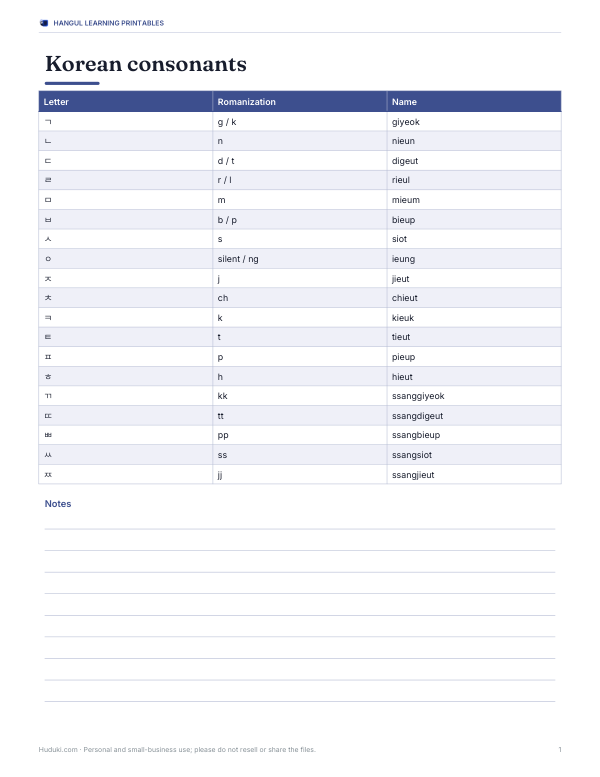
Korean consonants
| Letter | Romanization | Name |
|---|---|---|
| ㄱ | g / k | giyeok |
| ㄴ | n | nieun |
| ㄷ | d / t | digeut |
| ㄹ | r / l | rieul |
| ㅁ | m | mieum |
| ㅂ | b / p | bieup |
| ㅅ | s | siot |
| ㅇ | silent / ng | ieung |
| ㅈ | j | jieut |
| ㅊ | ch | chieut |
| ㅋ | k | kieuk |
| ㅌ | t | tieut |
| ㅍ | p | pieup |
| ㅎ | h | hieut |
| ㄲ | kk | ssanggiyeok |
| ㄸ | tt | ssangdigeut |
| ㅃ | pp | ssangbieup |
| ㅆ | ss | ssangsiot |
| ㅉ | jj | ssangjieut |
Where two romanizations are shown, the first is used at the start of a syllable before a vowel and the second at the end of a syllable (for example ㄱ is g in 가 “ga” but k in 박 “bak”). ㅇ is silent at the start of a syllable and pronounced “ng” at the end. The five doubled letters are tense consonants, said with more tension and no puff of air.
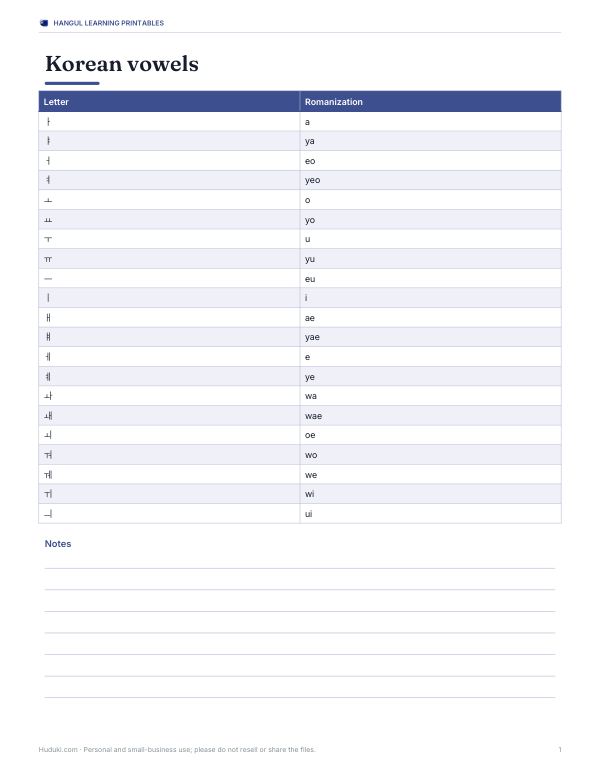
Korean vowels
| Letter | Romanization |
|---|---|
| ㅏ | a |
| ㅑ | ya |
| ㅓ | eo |
| ㅕ | yeo |
| ㅗ | o |
| ㅛ | yo |
| ㅜ | u |
| ㅠ | yu |
| ㅡ | eu |
| ㅣ | i |
| ㅐ | ae |
| ㅒ | yae |
| ㅔ | e |
| ㅖ | ye |
| ㅘ | wa |
| ㅙ | wae |
| ㅚ | oe |
| ㅝ | wo |
| ㅞ | we |
| ㅟ | wi |
| ㅢ | ui |
The first ten are the basic vowels; the rest combine them. Vertical vowels (ㅏ ㅓ ㅣ …) sit to the right of the initial consonant, and horizontal ones (ㅗ ㅜ ㅡ …) sit below it. A syllable that starts with a vowel sound uses the silent ㅇ as its initial, as in 아 “a”.
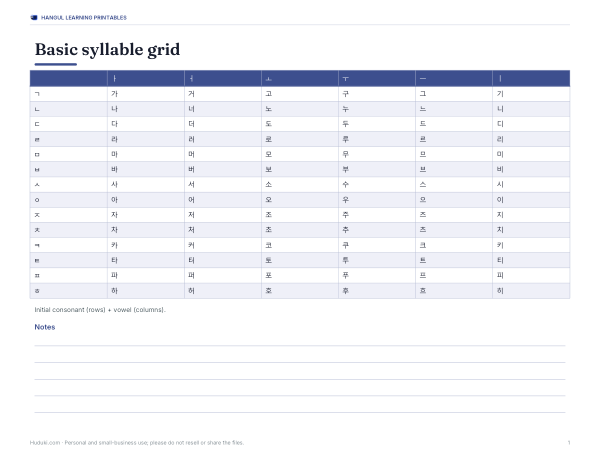
How syllable blocks work
| Pattern | Example | Meaning / romanization |
|---|---|---|
| Consonant + vertical vowel | 가 | ga |
| Consonant + horizontal vowel | 고 | go |
| Consonant + vowel + final | 각 | gak |
| Silent ㅇ + vowel | 아 | a |
| Complex vowel | 과 | gwa |
| Double final | 닭 | dak (chicken) |
Every Hangul syllable fits in a square block, which is why Unicode can list all 11,172 possible blocks in order. The builder computes each block from its parts the same way.
Revised Romanization and pronunciation
South Korea’s official Revised Romanization (2000) writes 한국어 as “hangugeo”, applying sound changes between syllables. The builder romanizes syllable by syllable — “han-guk-eo” — which shows the spelling clearly but not every sound change. For example, a final consonant often carries over to the next syllable when it starts with a silent ㅇ (liaison), and ㄴ next to ㄹ can become “ll”. Treat letter-by-letter romanization as a reading aid and listen to native speakers for pronunciation.
How to use the builder
- Pick an initial consonant (use ㅇ for syllables that start with a vowel).
- Pick a vowel.
- Optionally pick a final consonant (batchim), or ∅ for none.
- The block, its letters, romanization and Unicode code point appear.
- Add syllables to build a word, or type Hangul directly, and press Say word to hear it if your device has a Korean voice.
Worked example
To write 한 (han, “one/Korean”), choose ㅎ, ㅏ and final ㄴ. Then 국 is ㄱ + ㅜ + ㄱ (guk) and 어 is ㅇ + ㅓ (eo). Together they spell 한국어, “Korean language”, romanized letter by letter as han-guk-eo; in official Revised Romanization it is written hangugeo because the final ㄱ of 국 links to the following vowel.
Letter shapes and their logic
Hangul was created in 1443 under King Sejong the Great to make reading and writing accessible to everyone. The basic consonants picture the speech organs: ㄱ shows the tongue touching the back of the mouth, ㄴ the tongue touching the ridge behind the teeth, ㅁ the closed mouth, ㅅ a tooth and ㅇ the throat. Adding a stroke makes a stronger sound (ㄱ → ㅋ, ㄷ → ㅌ). Vowels are built from three symbols: a dot for heaven (now a short stroke), a horizontal line for earth (ㅡ) and a vertical line for a person (ㅣ).
Common beginner words
| Hangul | Letter-by-letter | Meaning |
|---|---|---|
| 안녕하세요 | an-nyeong-ha-se-yo | hello |
| 감사합니다 | gam-sa-hap-ni-da | thank you (pronounced gamsahamnida) |
| 네 | ne | yes |
| 아니요 | a-ni-yo | no |
| 물 | mul | water |
| 밥 | bap | rice / meal |
The difference between letter-by-letter spelling and pronunciation in 감사합니다 shows why listening matters: ㅂ before ㄴ is pronounced like ㅁ.
Learning tips
- Learn the ten basic vowels and fourteen basic consonants first — that covers most words.
- Notice the shapes: consonants like ㄱ ㄴ ㅁ ㅅ ㅇ were designed to picture the mouth and tongue.
- Practise writing blocks by hand; stroke order runs top to bottom, left to right.
- Read signs, menus and song lyrics to practise decoding.
- Most learners can read Hangul within a few days of practice.
Privacy
Everything runs in your browser. Speech uses your device’s built-in voices; nothing is sent to a server by this page.
Frequently asked questions
How many letters are in the Korean alphabet?
24 basic letters (14 consonants and 10 vowels), plus doubled consonants and combined vowels — 19 consonants and 21 vowels in total.
How do Hangul syllables work?
Each block has an initial consonant, a vowel and optionally a final consonant.
What does ㅇ sound like?
Silent at the start of a syllable; “ng” at the end.
What is batchim?
The final consonant at the bottom of a syllable block.
Which romanization system is used?
Revised Romanization of Korean, applied syllable by syllable.
Can I hear the pronunciation?
Yes, if your device has a Korean text-to-speech voice.
How long does it take to learn Hangul?
Many learners can read it within a few days of focused practice.
Is Korean written left to right?
Yes, today it is written left to right in horizontal lines, like English.
What is the difference between ㅐ and ㅔ?
They were once distinct but most speakers in Seoul now pronounce both close to “e”.